

Beyond Implants: Rediscovering Our Roots

By: Dr. Rahim Karmali
Dentistry stands at a crossroads, where the gleam of titanium implants casts a shadow over the humble, yet resilient, natural tooth. Over the past two decades, implants have transformed restorative care, boasting 10-year survival rates of 93-97%. But in our enthusiasm for this modern marvel, have we begun to sideline the time-honored craft of saving teeth?
THE SHIFTING PARADIGM: IMPLANTS VS. PRESERVATION
The surge in implant placements—projected to reach 5.7 million annually in the U.S. by 2026—reflects their undeniable popularity. Yet, this growth coincides with a 15-20% uptick in extractions of salvageable teeth, as noted in recent endodontic literature. Why the rush to replace? Endodontically treated teeth, when effectively managed, achieve 87-93% survival over 8-10 years, rivaling implants while preserving proprioception and bone integrity without invasive surgery. This predictability can be achieved with a straightforward and efficient treatment flow.
Financially, the disparity is stark. A comprehensive implant restoration—including extraction, bone grafting, possible sinus lift and crown—can exceed $4,000-$10,000, dwarfing the $1,000-$3,500 for root canal treatment and restoration. For patients with financial constraints, maintaining a compromised tooth might be their only practical option.
Medically vulnerable individuals, such as those with osteoporosis on bisphosphonates or poorly controlled diabetes, face elevated complication risks with implants, including delayed healing or failure rates up to 20% higher. Moreover, patient surveys reveal overwhelming preference: 94% of adults prioritize retaining natural teeth as long as practical, citing emotional attachment and natural feel.
This return to preserving compromised teeth requires a restorative-driven mindset, where we evaluate teeth holistically before condemning them. By prioritizing preservation, we uphold ethical standards, reduce lifetime costs and enhance satisfaction—studies show preserved teeth yield 10-15% higher long-term contentment scores than prosthetics. Furthermore, once a compromised tooth can no longer be maintained, then an implant can always be placed. Once a tooth is extracted and an implant is placed, future options
become much more constrained and complicated.
SYNERGIZING INNOVATION AND TRADITION IN PRACTICE
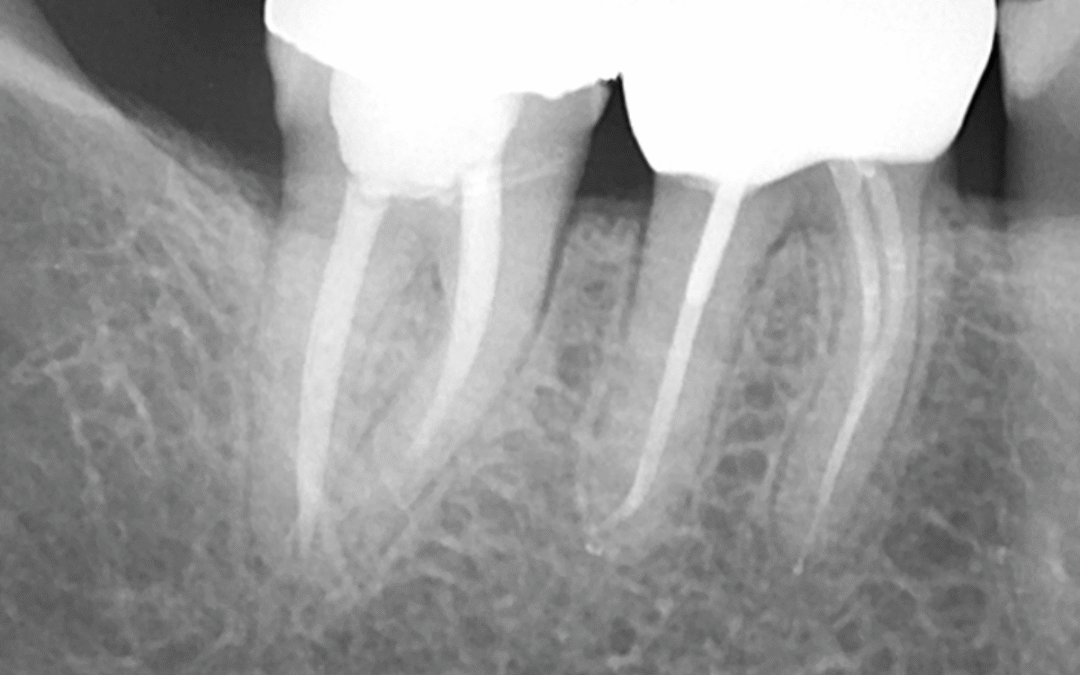
Tooth preservation thrives on blending innovative tools with proven methods. Take a 76-year-old retiree with severe pain #30. Traditional radiographs suggested a near hopeless prognosis. CBCT revealed that aside from the deep distal caries, sufficient tooth structure remained to make treatment possible. Extraction was discussed as the most predictable option; however, the financial commitment was too large for her to overcome. Treatment was initiated with a full disassembly to verify restorability. A gingivoplasty was performed with a soft-tissue laser and a bonded pre-endo buildup was placed under perfect isolation. The canal system was debrided and disinfected using laser-enhanced irrigation. The tooth was medicated and temporized. At the completion appointment, her symptoms had fully resolved. The soft tissue around the deep caries was completely healthy. The canal system was obturated and a surgical steel post was placed. Her restorative dentist then placed a well-adapted crown. This restoratively driven endodontic approach made a complicated clinical situation routine and predictable for her and her restorative dentist. Eight years on, the tooth is still asymptomatic and functional, sparing this patient thousands of dollars on an implant investment.
FORWARD TOGETHER: A BALANCED FUTURE IN DENTISTRY
As dentistry evolves in our ability to replace teeth, let’s not forget our roots. “Beyond Implants” advocates for harmony in using implants where needed but championing preservation as the ethical default.
Dr. Rahim Karmali is a clinical endodontist practicing in Denver, CO. He earned his BS and DDS from the University of Washington. He served as a Dental Officer with the US Navy and Marines before specializing in Endodontics at the Long Beach Veterans Administration Medical Center.